

There's one word that's unanimous among customers and suppliers of any product: quality. An industrial structure or residential installation requires highly functional parts with unique characteristics. The valve and fittings sector is no exception.
Working with the right parts and tools can make all the difference in the final result of a project or maintenance project. In this context, one of the most important and necessary items for a piping system is flanges . Do you know what these accessories do? And what are the main types of flanges on the market? Check out a general overview of this indispensable product!
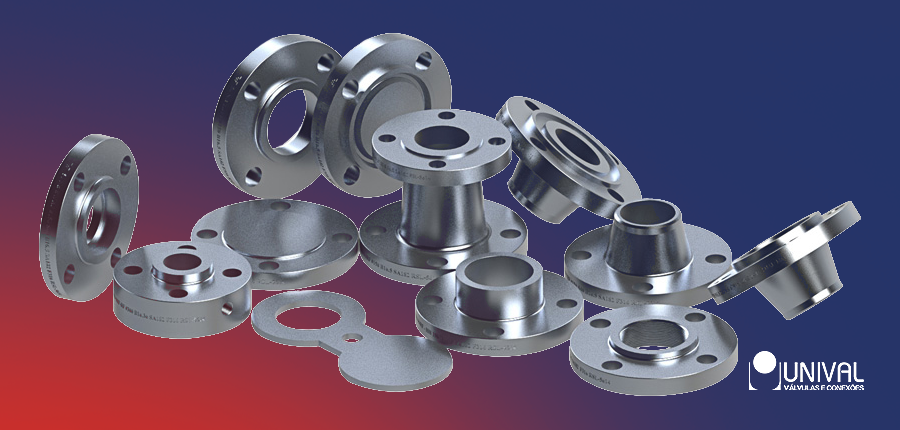
Flanges are elements that join two components of a piping system. They are usually joined by bolts and assembled in pairs, allowing for disassembly without destructive operations. Their basic function is to seal the connection and prevent fluids from escaping.
Now, let's learn a little more about the different types of flanges available on the market!
Blind flanges are the most popular type available on the market. They lack a central hole and are primarily used at the ends of piping systems, allowing for line inspection and future continuation.
Used to close lines and flanged sections, it can also be used under different temperature and pressure conditions.
The neck flange type is designed to transfer stress to the pipe. This reduces the pressure concentration at its base. They are known for their tapered neck and resistance to deformation.
They have a beveled end, facilitating butt welding and in-line radiography testing. Due to their structure, they are used in a variety of pressure and temperature conditions, making them popular sealing elements in the market.
The lap-joint flange, also known as a loose flange, is used with a convenient stub-end insert for piping that requires frequent disassembly. They can rotate and allow for easy hole alignment.
This flange is used in line assemblies that use flanges and are not subject to corrosion by the fluid, as they are made of carbon steel.
This type is most commonly used in the orifice plate assembly industry. The holes in these flanges are used to measure the flow of liquids and gases passing through the pipe. Compared to other types, it offers the advantage of having additional bolts to facilitate the separation of the flanges for inspection or maintenance.
It's an economical, easy-to-assemble device used in a variety of industrial applications. It can be joined to pipes without welding and is best used at medium pressures and ambient temperatures.
This flange slides over the pipe before being welded. Ideal for low-pressure applications, it does not allow for direct connection to a tubular fitting or radiographic testing on the line. It requires welding on both the inside and outside. It can be used at various temperatures and moderate pressures.
The socket flange, used in various industries such as oil, natural gas, etc., can be operated in any moderate temperature and pressure condition, but in severe thermal gradients, its use is not recommended.
This style of flange is installed in piping to achieve a tight fluid shutoff. They are even used in place of valves in locations where shutoffs need to be performed periodically.
Unival , a leading supplier of valves and fittings in Brazil, offers a wide range of flanges. Why not speak with our experts to learn more about the features and specifications of each part? Contact us!